
All Services
Our Team
All Services

Guaranteed Income & Longevity Planning | BTO Financial Group
Retirement planning is not only about how much you accumulate—it is also about how you convert what you have into reliable income for as long as you live. As life expectancy increases and traditional pensions become less common, many individuals and families are more focused on two essential planning goals:
Guaranteed income planning: creating dependable income that is designed to continue based on defined contract terms.
Longevity planning: building a strategy to help address the risk of outliving retirement savings.

Guaranteed Income & Longevity Planning
At BTO Financial Group, we take an education-first approach to guaranteed income and longevity planning. We’ll help you understand your options, compare tradeoffs, and choose a strategy aligned with your goals—without pressure and without confusing jargon.
Why Choose an Education-First Approach?
We emphasize education, clarity, and transparency to help individuals and families better understand insurance-based retirement planning strategies and make informed decisions.
01.
Education Comes First
We prioritize education and understanding, taking the time to explain insurance-based retirement planning options clearly—so you can make decisions that feel informed and comfortable.
02.
Transparent Planning Process
Our approach is built on clarity and transparency. We walk through available options, explain how different strategies work, and answer questions without pressure or obligation.
03.
Professional
Guidance
As a licensed insurance professional, we provide guidance focused on insurance-based retirement planning strategies designed to support long-term planning goals.
Why Guaranteed Income and Longevity Planning Matter
Many retirement strategies rely heavily on investment performance and ongoing withdrawals. While market growth can be beneficial, retirement introduces unique risks that are often underestimated.
Common retirement risks include:
01.
Longevity risk:
The risk that a retiree lives longer than expected and outlives their available income or assets.
02.
Sequence-of-returns risk:
The risk that market declines early in retirement, combined with withdrawals, permanently reduce portfolio sustainability even if long-term returns are positive.
03.
Inflation risk:
The risk that rising costs over time reduce purchasing power and make a fixed level of income insufficient to maintain lifestyle.
04.
Healthcare expense risk:
The risk that medical, long-term care, or out-of-pocket health costs are higher or last longer than anticipated in retirement.
05.
Survivor planning risk:
The risk that household income is reduced or certain benefits are lost after the death of a spouse, impacting the surviving partner’s financial security
06.
Tax Risk:
Changes in tax law or higher taxable income in retirement (from RMDs, Social Security taxation, or portfolio withdrawals) can reduce net spendable income and disrupt a retirement income plan.
Guaranteed income and longevity planning are designed to address these risks by adding structure and predictability to retirement income.
What Is Guaranteed Income Planning?
Guaranteed income planning focuses on building an income foundation that is intended to be predictable and contractually defined, so essential expenses are not dependent solely on market performance.
A practical framework many retirees find helpful is separating retirement spending into two categories:
01.
Essential expenses:
Housing, utilities, food, baseline transportation, insurance, and basic healthcare.
02.
Discretionary expenses:
Travel, hobbies, entertainment, gifting, and lifestyle enhancements
Guaranteed income strategies are often considered for essential expenses, helping create a baseline of income that may improve stability and confidence in retirement decisions.
Pre-Register for Our Free Educational Webinar Series
Get practical, education-first guidance designed to help individuals and families build confidence around retirement, insurance, and long-term financial planning—at any stage of life.
What Is Longevity Planning?
Longevity planning is the process of designing retirement income with the expectation that retirement may last several decades. Instead of planning to a fixed end date, longevity planning focuses on building income strategies intended to remain durable across changing circumstances.
Longevity planning often involves:
01.
Coordinating income sources over time (Social Security, pensions, retirement accounts, insurance-based income)
02.
Planning for market volatility and extended down periods
03.
Evaluating how inflation may affect future spending needs
04.
Addressing potential healthcare and long-term care considerations
05.
Structuring income for one lifetime or two (spousal planning)
The objective of longevity planning is not to predict every future expense, but to build a plan designed to function across a range of realistic outcomes.
Clarity Makes Retirement Planning Simpler
Through an education-first approach, we help individuals and families better understand insurance-based retirement planning strategies and navigate important decisions with clarity. Our focus is on transparency, understanding options, and thoughtful long-term planning.



Clarity Makes Retirement Planning Simpler
Through an education-first approach, we help individuals and families better understand insurance-based retirement planning strategies and navigate important decisions with clarity. Our focus is on transparency, understanding options, and thoughtful long-term planning.
Common Sources of Retirement Income
Most retirement income strategies use a combination of income sources. Guaranteed income planning typically begins by clarifying what income may already be available and identifying potential gaps.
Common retirement income sources include:
- Social Security
- Pensions (when applicable)
- Personal savings and retirement accounts
- Insurance-based income strategies (often annuity-based solutions, when appropriate)
Guaranteed income and longevity planning help coordinate these sources into an organized income strategy rather than treating each in isolation.


How Insurance-Based Guaranteed Income Strategies Typically Fit In
When people refer to “guaranteed income,” they are often describing insurance-based strategies designed to provide income under defined contract terms. These strategies may be considered to help reduce reliance on portfolio withdrawals for essential expenses.
Education-first planning typically includes clarity around:
01.
Income Start Timing
Some strategies are designed to begin income soon, while others are structured for income to start later, depending on retirement timing and objectives.
02.
Lifetime Income Options
Depending on the contract, income may be structured for:
A single lifetime
Joint lifetimes (for spouses)
A defined period, where applicable
03.
Spousal and Survivor Considerations
For couples, income planning often includes decisions about how income continues for a surviving spouse. Survivor planning is a key component of longevity planning.
04.
Liquidity Access
Insurance-based income strategies often include specific rules related to access, withdrawals, and time-based charges. Understanding liquidity needs is an important part of the evaluation process.
05.
Costs, Fees & Tradeoffs
Some strategies include costs or optional features that affect income, flexibility, or legacy outcomes. Part of professional planning is understanding what those tradeoffs are and why they exist.
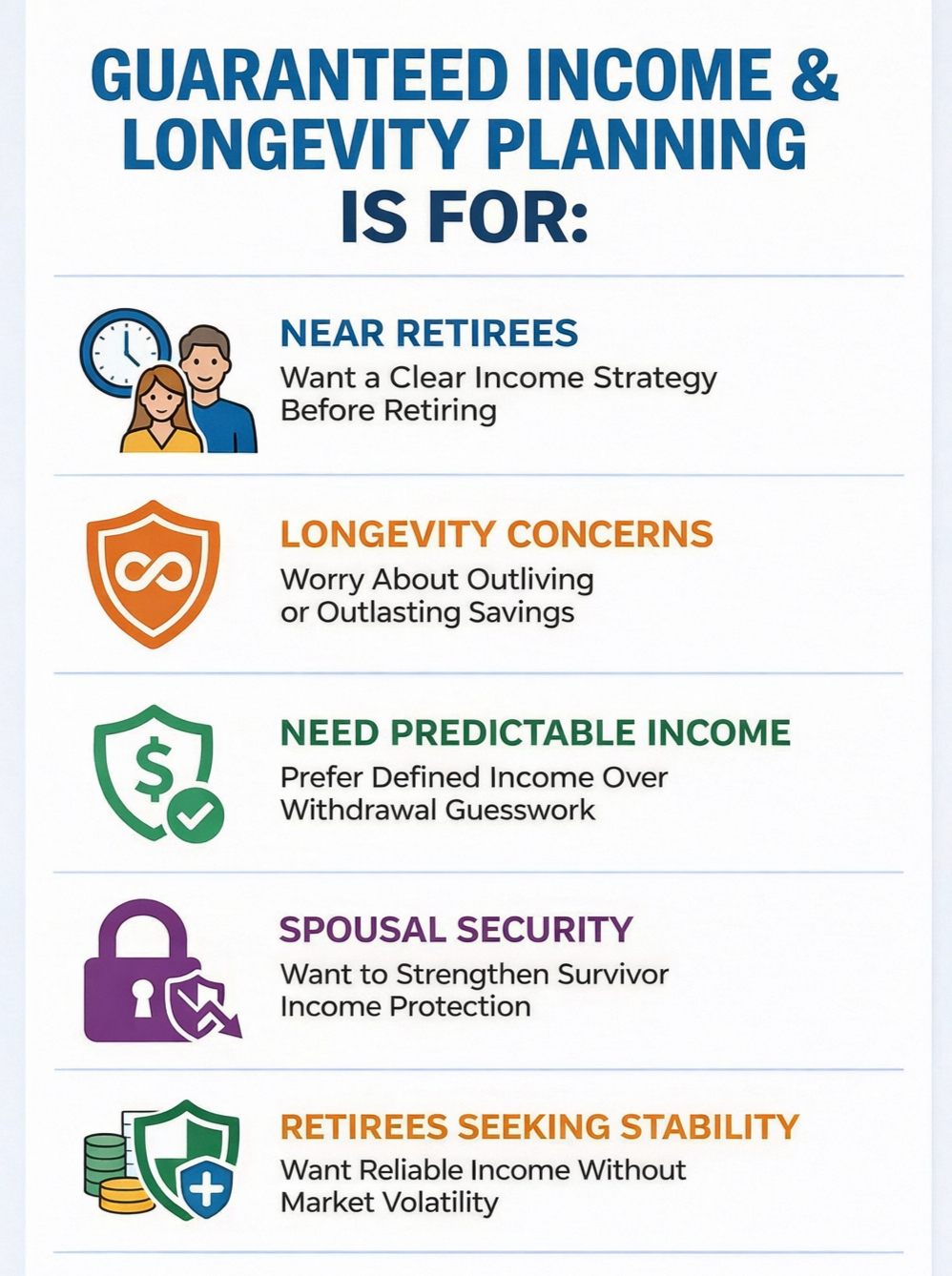
Who This Planning Service Is Designed For
Guaranteed income and longevity planning may be especially relevant if you:
- Are approaching retirement and want a clear income framework
- Want essential expenses supported by predictable income sources
- Are concerned about outliving savings
- Prefer defined income structure rather than relying solely on withdrawals
- Want to strengthen spousal and survivor income planning
- Are already retired and want to improve income stability
Key Questions a Guaranteed Income Plan Helps Address
A structured retirement income plan typically seeks to answer questions such as:
What are your essential monthly expenses in retirement?
What reliable income sources will be available (Social Security, pension, etc.)?
Is there a gap between essential expenses and reliable income?
How much flexibility is needed for emergencies or unexpected costs?
How should income continue for a surviving spouse?
What tradeoffs are acceptable between income strength, liquidity, and legacy goals?
Our Process At BTO Financial Group
This process is designed for individuals and couples seeking predictable retirement income and strategies to help address the risk of outliving their savings.
initial discovery call
retirement SNAPSHOT REVIEW
essential expense identification
Longevity & Retirement Risk Review
guaranteed income goal definition
Education-Based Guaranteed Income Options Review
Customized Income & Longevity Strategy
Implementation & Secure Client Portal Access
ongoing reviews and Plan adjustments
Common Planning Gaps our Process helps address
Retiring without a written income plan
Relying solely on withdrawals without addressing longevity risk
Assuming consistent market performance in retirement
Selecting income products without understanding liquidity limitations
Overlooking survivor income outcomes
Failing to coordinate Social Security, pension, and retirement income timing
Looking for more information?
Frequently Asked Questions
We understand lorem ipsum dolor sit amet, consectetur adipisicing elit.
Question 1: What does “guaranteed income” mean in retirement planning?
It generally refers to income provided under defined contract terms. Guarantees, when available, are backed by the claims-paying ability of the issuing insurance company and subject to contract provisions.
Question 2: Can mortgage protection pay off my home entirely?
No. Many individuals begin this planning years before retirement to reduce uncertainty and coordinate future income decisions.
Question 3: Will guaranteed income reduce flexibility?
It depends on the strategy. Some approaches involve tradeoffs between income predictability and liquidity. A review helps clarify those tradeoffs.
Question 4: What happens if one spouse passes away?
This depends on how income sources are structured. Spousal and survivor income planning should be addressed upfront.
Question 5: Are annuities the only tool for longevity planning?
No. Longevity planning often involves multiple coordinated income sources. Insurance-based income strategies are one potential component.
Question 6: How do I know what income level is realistic?
Planning typically starts with essential expenses and reliable income sources, then evaluates gaps and possible solutions.
Still Have Questions?
We have the Answers!
Contact
19220 Space Center BLVD, Houston Texas 77058
Texas +1 346-584-2454
North Carolina +1 984-464-8511
Virginia +1 571-946-1553
Providing education-focused guidance to help individuals and families make informed insurance and retirement planning decisions.
Our Social Media Sites will be live in Feb 2026


Business Hours
Mon - Sat : 9AM - 4PM
Sunday: 9AM - 4PM
© BTO Financial Group. 2026. All Rights Reserved.