
All Services
Our Team
All Services

Family Insurance Guidance | BTO Financial Group
Protecting a family isn’t only about having “a policy.” It’s about creating a plan that helps your household stay financially stable if life throws a curveball—an unexpected death, illness, or loss of income.
Protecting a family isn’t only about having “a policy.” It’s about creating a plan that helps your household stay financially stable if life throws a curveball—an unexpected death, illness, or loss of income.

At BTO Financial Group, we take an education-first approach to family insurance planning. That means we’ll help you understand your options, compare strategies, and choose coverage aligned with your family’s needs—without pressure and without jargon.
Why Choose an Education-First Approach?
We emphasize education, clarity, and transparency to help individuals and families better understand insurance-based retirement planning strategies and make informed decisions.
01.
Education Comes First
We prioritize education and understanding, taking the time to explain insurance-based retirement planning options clearly—so you can make decisions that feel informed and comfortable.
02.
Transparent Planning Process
Our approach is built on clarity and transparency. We walk through available options, explain how different strategies work, and answer questions without pressure or obligation.
03.
Professional
Guidance
As a licensed insurance professional, we provide guidance focused on insurance-based retirement planning strategies designed to support long-term planning goals.
What “Family Insurance” Usually Means
When most people say “family insurance,” they’re typically talking about life insurance and related protection planning designed to support the people who depend on you financially.
01.
Replacing lost income so your family can keep paying bills
02.
Paying off major debts (mortgage, car loans, credit cards)
03.
Funding childcare and day-to-day living expenses
04.
Covering final expenses and medical bills
05.
Creating stability for long-term planning (education, legacy, and future goals)
06.
Providing liquidity at the right time so survivors aren’t forced to sell assets, drain savings, or make rushed financial decisions during a difficult period
What “Family Insurance” Usually Means
When most people say “family insurance,” they’re typically talking about life insurance and related protection planning designed to support the people who depend on you financially.
01.
Replacing lost income so your family can keep paying bills
02.
Paying off major debts (mortgage, car loans, credit cards)
03.
Funding childcare and day-to-day living expenses
04.
Covering final expenses and medical bills
05.
Creating stability for long-term planning (education, legacy, and future goals)
06.
Providing liquidity at the right time so survivors aren’t forced to sell assets, drain savings, or make rushed financial decisions during a difficult period
Clarity Makes Retirement Planning Simpler
Through an education-first approach, we help individuals and families better understand insurance-based retirement planning strategies and navigate important decisions with clarity. Our focus is on transparency, understanding options, and thoughtful long-term planning.



Clarity Makes Retirement Planning Simpler
Through an education-first approach, we help individuals and families better understand insurance-based retirement planning strategies and navigate important decisions with clarity. Our focus is on transparency, understanding options, and thoughtful long-term planning.
Who Family Insurance Planning Helps the Most
Family insurance is especially relevant if you are:
- Newly married or recently partnered
- A new parent (or growing your family)
- A single parent
- A homeowner with a mortgage
- Supporting aging parents or family members
- The primary income earner—or the primary caregiver
And yes—stay-at-home parents and non-working spouses often need coverage too. If something happened, the financial impact of replacing childcare, transportation, and household management can be significant.


How Much Life Insurance Do Families Usually Need?
There’s no one-size-fits-all number, but there is a smart way to estimate.
A practical needs-based review often looks at:
01.
Income Replacement
How many years of income would your family need?
02.
Debt Payoff
Mortgage, personal loans, credit cards
03.
Child Related Costs
Childcare, schooling, college goals
04.
Final Expenses
Funeral costs and potential medical bills
05.
Emergency Buffer
A cushion for unexpected expenses
A common mistake is choosing a number that “sounds reasonable” instead of matching coverage to actual needs. Education-first planning helps you connect the dots.
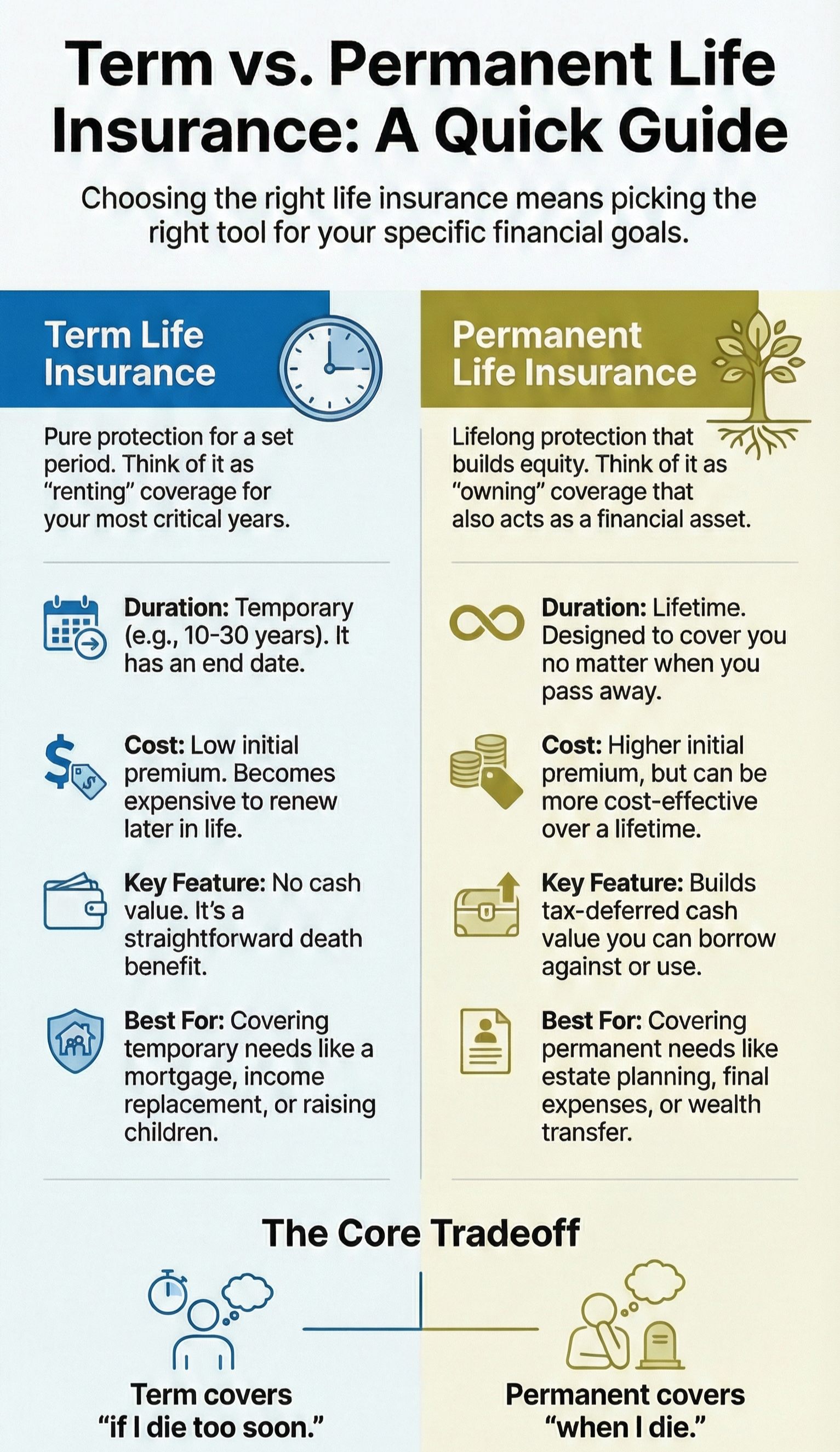
Term vs Permanent Life Insurance (In Simple Terms)
Term life is often used to cover high-need years (raising kids, paying a mortgage). It’s typically designed for a set period of time (like ten, twenty, or thirty years).
Often used for: income replacement, mortgage protection, young families on a budget.
Permanent coverage is designed to last longer (as long as the policy is maintained). Some types may build cash value, and some strategies are used for lifetime protection and legacy planning. These include WHOLE LIFE, UNIVERSAL LIFE and INDEXED UNIVERSAL LIFE Insurance.
Often used for: lifetime coverage needs, final expense planning, long-term family goals, legacy strategies.
The right mix depends on your goals, budget, health, and how long your family depends on your income.
Key Decisions Families Should Understand
When building a family insurance plan, the “details” are not small details. Education matters most in areas like:
01.
Policy Ownership - Who Owns the Policy and Why it Matters
The policy owner is the legal controller of the life insurance contract. This person (or entity) has authority to make changes.
What the owner can do:
Change beneficiaries
Adjust coverage or riders (subject to policy terms)
Transfer ownership
Cancel the policy
Access cash value (if applicable)
Why it matters:
Control ≠ Insured: The insured (the life being covered) is not always the owner. For example, a business may own a policy on a key employee, or parents may own a policy on a child.
Estate and tax implications: Ownership affects whether proceeds may be included in an estate, which can have tax consequences.
Divorce or business disputes: If ownership isn’t clearly aligned with intent, disputes can arise—even if beneficiaries seem correct.
Best practice:
Ownership should align with who needs control to fulfill the policy's purpose (family protection, business continuity, estate planning). Review ownership after major life events.
02.
Beneficiaries - Keeping them Accurate and Updated
Types:
Primary beneficiaries: First in line to receive proceeds
Contingent (secondary) beneficiaries: Receive proceeds if primary beneficiaries are deceased or ineligible
Why accuracy matters:
Life changes override intent: Marriage, divorce, births, deaths, and estrangement can quickly make beneficiary designations outdated.
Beneficiary designations usually override wills: Even if a will says otherwise, insurers pay based on the policy form.
Minor beneficiaries: Naming minors directly can delay payouts and require court involvement unless a trust or guardian is specified.
Best practice:
Review beneficiaries at least every 2–3 years and immediately after major life events. Use full legal names and clarify percentages.
03.
Coverage Length - Matching the Term to Years of Highest Risk
Coverage length (term) is how long the policy stays in force—commonly 10, 20, or 30 years for term insurance.
Why timing matters:
The goal is to cover financial vulnerability periods, such as:
Years with dependent children
Mortgage or rent obligations
Income replacement during peak earning years
Business debt or partner obligations
Too short = coverage may expire before risks end
Too long = unnecessary premium costs for risks that no longer exist
Best practice:
Map coverage length to your longest financial dependency, not your age alone. Many families ladder multiple terms (e.g., 20-year + 10-year) to reduce cost while maintaining protection.
04.
Riders (Optional Features): Customizing Protection
Riders are add-ons that modify or enhance the base policy. Availability and cost vary by insurer and policy type.
Common riders and why they matter:
Accelerated Death Benefit: Access part of the death benefit early if diagnosed with a terminal illness—useful for medical or end-of-life costs.
Waiver of Premium: Premiums are waived if the insured becomes disabled, preserving coverage during income loss.
Child Rider: Provides coverage for children, often convertible later without medical underwriting.
Conversion Rider (term policies): Allows conversion to permanent insurance without new health exams—valuable if health declines.
Trade-offs:
Riders increase premiums
Some duplicate existing coverage (e.g., disability insurance)
Others provide flexibility that’s impossible to add later
Best practice:
Add riders that protect against risks you can’t self-insure and that would be difficult or expensive to replace later.on for unexpected expenses
Our Process At BTO Financial Group
This process is built for families seeking clarity, protection, and long-term insurance guidance at every life stage.
initial discovery call
family needs snapshot
coverage gap analysis
options and
education
customized coverage strategy
application and underwriting suport
policy placement and approval
secure client portal access
ongoing policy reviews and life updates
Looking for more information?
Frequently Asked Questions
Some FAQ's are included below but we encourage you to request a slot on one of our Licensed Agent's Calendars to ensure you obtain the most accurate, thorough and up to date response.
Question 1: Is term life insurance “better” than whole life insurance?
Neither is universally better. Term often fits temporary needs (kids, mortgage). Permanent coverage may fit lifetime needs and long-term strategies. The right choice depends on your goals and budget.
Question 2: Do both parents need life insurance?
In many households, yes. Even if one parent earns less (or is a stay-at-home parent), the financial impact of losing childcare and household support can be large.
Question 3: Can I get coverage if I have health issues?
Often, yes. Options vary based on health history, age, and the type of coverage. We can explain what’s realistic and help you compare paths. We work with more than 30 carriers and know specifically which ones approve for certain health conditions.
Question 4: How long does it take to get approved?
Timelines vary. Some policies can be faster than others depending on underwriting requirements. We have access to instant approval policies.
Still Have Questions?
We have the Answers!
Contact
19220 Space Center BLVD, Houston Texas 77058
Texas +1 346-584-2454
North Carolina +1 984-464-8511
Virginia +1 571-946-1553
Providing education-focused guidance to help individuals and families make informed insurance and retirement planning decisions.
Our Social Media Sites will be live in Feb 2026


Business Hours
Mon - Sat : 9AM - 4PM
Sunday: 9AM - 4PM
© BTO Financial Group. 2026. All Rights Reserved.